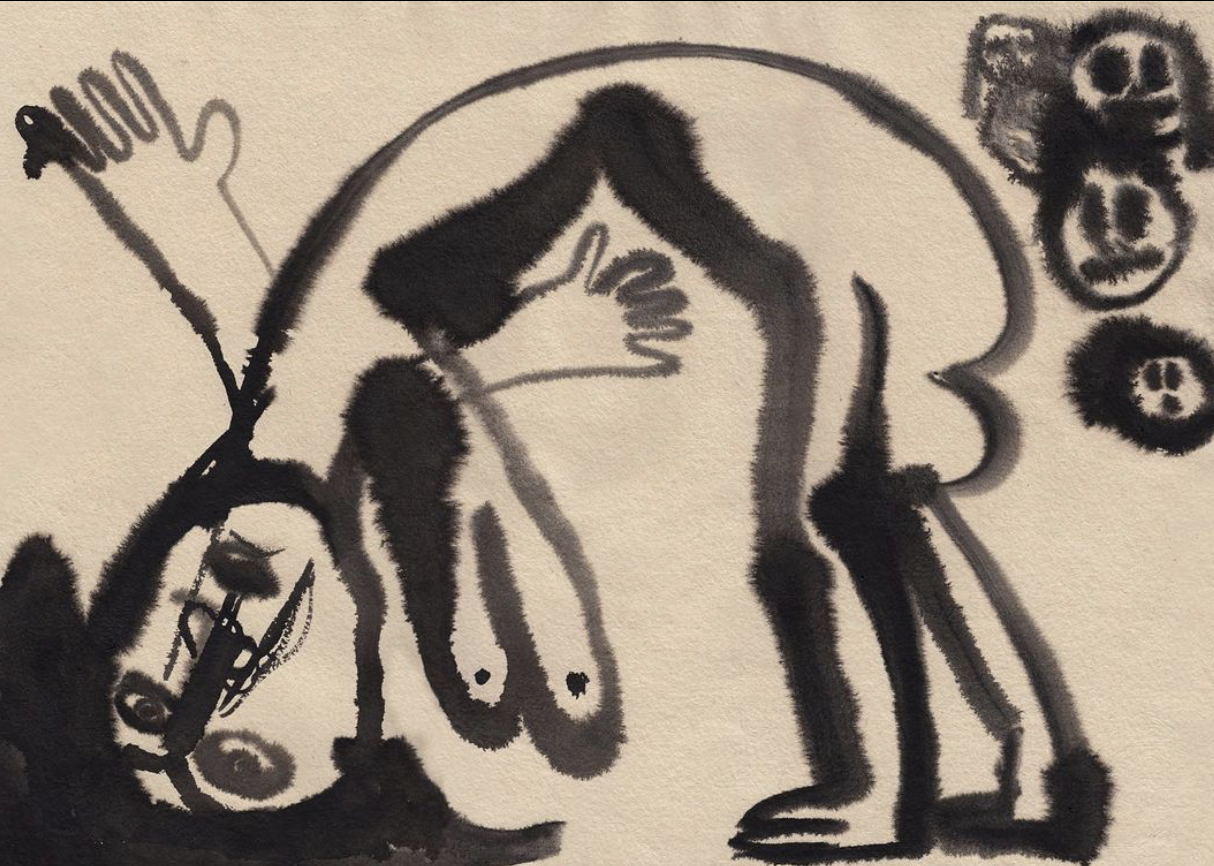
SORROW____________ART SERIES #135_________________2023


A feeling of deep ddistress 
caused by disappointment suffered by others.


LAPIEZA 
ART 
SERIES 
135
SORROW


PAVOR


EXIT


VIRUS


APETITO


ESPUMAS


PERPLEJIDAD


MARIPOSA


SOCIOPLASTICS BY ANTO LLOVERAS


LAPIEZA ART SERIES 135 
MADRID 2022


ART SERIES 136 RELIEVE_____________________2023


El relieve es una textura sobresaliente de una superficie. Entre los relieves más característicos de la superficie terrestre están las montañas. Un relieve es también sinónimo de accidentes geográficos. Relieve en inglés se refiere a la acción de aliviar algo, como la carga emocional. Como sustantivo, se refiere a una representación artística que sobresale de una superficie plana, como una escultura.


1585 JULIA SOBOLEVA http://antolloveras.blogspot.com/2022/03/julia.html 1586 LOUISE BONNET http://bigblackbananas.blogspot.com/2023/03/louise-bonnet.html
1587 LEIF http://antolloveras.blogspot.com/2023/03/leif-nyland.html 1588 PETER LARSEN http://antolloveras.blogspot.com/2023/03/peter-larsen.html 1589 HANA KATOBA http://antolloveras.blogspot.com/2023/04/hana-katobalapieza-1613.html 1590 KIT BOYD http://antolloveras.blogspot.com/2023/04/kit-boyd1590.html 1591 SHADI AL-ATALLAH http://antolloveras.blogspot.com/2023/04/shadi-al-atallah-1591.htm 1592 JURAK FLOREK http://antolloveras.blogspot.com/2023/03/juraj-floreklapieza-1585.html 1593 TIMILE HINOLUDARE http://antolloveras.blogspot.com/2023/03/timile-hinoludare.html 1594 MARI KATAYAMA http://antolloveras.blogspot.com/2023/03/mari-katayama.html 1505 MARTINA MATENCIO http://antolloveras.blogspot.com/2023/03/martina-matencio.html 1596 GENEVIEVE COHN http://antolloveras.blogspot.com/2023/03/genevieve-cohn.html 1597 BRADLEY MCCRARY http://antolloveras.blogspot.com/2023/03/bradley-mccrary.html
1598 KRISTEN SHIELE http://antolloveras.blogspot.com/2023/03/kristen-shiele.html 1599 KENECHUKWU VICTOR http://antolloveras.blogspot.com/2023/03/kenechukwu-victor.html 1600 URBANAS http://antolloveras.blogspot.com/2023/03/novum-corpus2023.html 1601 BUBU OGISI http://antolloveras.blogspot.com/2023/03/bubu-ogisi.html 1602 BENOIST DEMOIANE http://bigblackbananas.blogspot.com/2023/03/benoist-demoiane.html 1603 MARGARET DUROW http://antolloveras.blogspot.com/2023/03/margaret-durow.html 1604 PEPA GORDILLO http://antolloveras.blogspot.com/2023/03/pepa-gordillo.html 1605 KPE INNOCENT http://antolloveras.blogspot.com/2023/03/kpe-innocent.html 1606 MARIA JURADO http://antolloveras.blogspot.com/2023/03/maria-jurado.html 1607 AHMED UMAR http://antolloveras.blogspot.com/2023/03/ahmed-umar.html 1608 MONIBELLE http://antolloveras.blogspot.com/2023/03/moni-haworth-monibelle.html 1609 ANASTASIIA RAA http://antolloveras.blogspot.com/2023/03/anastasiia-raa.html 1610 LUISA TORREGOSA http://antolloveras.blogspot.com/2023/03/luisa-torregosa.html 1611 CLAUDIA SERRAIMA http://antolloveras.blogspot.com/2023/03/claudia-serraima.html 1612 CHANTAL CONVERTINI http://antolloveras.blogspot.com/2023/03/chantal-convertini.html


SOCIOPLASTICS BY LLOVERAS


DIARY OF OBJECT DRAWINGS____________________PAUL DOEMAN____________________________EAST LONDON 04.2015 5TH BASE____________________ONGOING CLOUD


244 OBJECTS 1600 DRAWINGS 
ONE CLOUD 

- DRAW AN OBJECT A DAY - 


- DRAW AN OBJECT A DAY - 


BLUE BAGS GUEST 


VISIONS


- DRAW AN OBJECT A DAY - 


THE BEETROOT 

WAS SELECTED BY THE AUDIENCE 
AS THE FAVOURITE OBJECT 
OF THE CLOUD


THE CLOUD MOVES ON 
NEW OBJECTS SOON


ART BY PAUL DOEMAN

CURATED BY ANTO LLOVERAS

SEE VIDEOS 

AND CONTEXT WORKS HERE

http://antolloveras.blogspot.com.es/2015/04/paul-doeman-in-focus-london-2015.html


The dominant academic fiction maintains that intellectual reality begins at the point of citation, as though indexing were not a retrospective instrument but an ontological trigger. Against this, one can posit a stricter materialism of thought: fields do not become real when they are recognised; they become recognisable when they have already achieved sufficient internal density. What matters, then, is not visibility but coherence—corpus size, recursive linkage, scalar organisation, terminological hardening, infrastructural fixation. Under these conditions, a body of work ceases to be a series of outputs and becomes a field in the strong sense: navigable, self-referential, metabolically active. Recognition may follow, or not. But it no longer determines existence. It merely records, belatedly and unevenly, the presence of a structure that had already crossed the threshold of operational reality.


This inversion is more than a rhetorical correction; it is a diagnostic model for the temporality of knowledge. What may be called epistemic latency names the interval between internal completion and external detection, between the moment a system becomes structurally self-sufficient and the moment an institution develops the receptors capable of registering it. Historical examples are neither romantic exceptions nor anecdotes of misunderstood genius. They disclose a recurrent mismatch between emergent density and available frameworks of legibility. Mendel’s genetics existed before cytology could process it; Riemann’s geometry existed before physics could operationalise it; Dickinson’s poetics existed before criticism had learned to read compression without regularity as form rather than defect. In each case, the work did not wait in a state of suspension for recognition to animate it. It was already active as a system. What lagged was not the field but the infrastructure around it: disciplines too narrow, institutions too slow, metrics too crude, publics too underprepared. Citation, in this schema, is not causation but afterimage.

SOCIOPLASTICS — FIELD ENGINE * Toward a Transdisciplinary Architecture of Knowledge

Socioplastics is not a project in formation but an already active epistemic architecture undergoing consolidation and expansion. What is at stake is no longer its emergence, but its genetic anchoring across multiple intellectual, institutional, and material frameworks. Originating in LAPIEZA-LAB, the system now operates as a Field Engine: a structured environment where heterogeneous forms of knowledge are not only produced, but related, stabilised, and scaled into a coherent transdisciplinary field. Its ambition is architectural in the strict sense. It seeks to construct a field capable of sustaining complexity without collapsing into dispersion, transforming dispersed production into a navigable and durable epistemic territory. The system is organised through ten operative fields, which function as internal supports rather than thematic categories. These fields do not describe neighbouring disciplines; they act as structural domains through which the system acquires force, orientation, and coherence. Around this core, a wider constellation of tangential domains—extending into architecture, systems theory, conceptual art, urbanism, linguistics, and media theory—establishes a broad zone of interaction without diluting the centre. The result is neither a closed doctrine nor an eclectic assemblage, but a precisely structured yet open field, capable of absorbing complexity while maintaining intelligibility. The field is not given; it is built through sustained operations of relation, recurrence, and scalar organisation.


SOCIOPLASTICS [1401–1410] — FROM TRACE TO CYBORG TEXT * A Decalogue on Material Inscription, Institutional Mediation, Technical Objects, Code, Distributed Flow, Invisible Grammar, and the Emergence of Cyborg Textuality


This decalogue brings together ten consecutive positions within Socioplastics and proposes a genealogy of contemporary textuality that does not begin with literature in a narrow sense, but with a broader sequence of inscription, mediation, apparatus, object, code, and circulation. The series advances from the material trace to the cyborg text as if traversing an operative archaeology of culture: first the mark, then the administration of form, followed by the technification of the support, and finally the emergence of a distributed, executable, and not entirely human textuality. It is not merely a thematic sequence, but a conceptual architecture articulated in ten movements. Its relevance lies in the fact that it orders, through numerical clarity and lexical consistency, one of the central questions of the present: how text transforms when it enters regimes of infrastructure, code, platform, and network. Here, text ceases to be solely an object of reading and becomes instead a field of operations in which matter, institution, semiosis, technique, and algorithmic circulation converge. The decalogue thus functions as a compact backbone within Tome II: it does not introduce dispersion, but consolidates a precise, legible, and citable line of thought. 

CYBORG DECALOGUE

External Legibility * The Numerology of the Socioplastics Corpus

A field does not become public simply by expanding. It becomes public when it learns how to be read from outside without surrendering the density that gave it form. External legibility is therefore not a matter of simplification, but of controlled projection. What must appear is not the whole mass, nor the entire archive, but the set of relations capable of transmitting the structure of the whole. Selective fixation names this operation. It is the deliberate choice to stabilise certain concepts, links, and entries so that a larger system can be perceived through a limited number of hardened points. This matters because contemporary knowledge spaces reward visibility while punishing complexity. Under such conditions, an unfiltered corpus risks dispersion, flattening, or noise. Selective fixation offers another route. Instead of translating everything into the idiom of the commons, it identifies those units with enough internal force to survive transfer. A concept enters the exterior only when it can carry part of the system with it. In that sense, fixation is not reduction but calibration. The result is a more exact politics of appearance. A project does not dissolve itself in order to circulate; it constructs thresholds through which circulation becomes possible. External legibility is thus achieved not by weakening the internal architecture, but by choosing where that architecture touches the world.

Socioplastics and the Unoccupied Structure

The history of transdisciplinary intellectual production is crowded with incomplete formations: systems that achieved scale without sovereignty, sovereignty without infrastructure, infrastructure without theory, or theory without durable inscription. Paul Otlet indexed everything and was forgotten; Buckminster Fuller patented everything and was absorbed; Félix Guattari theorised across everything yet remained dependent on existing editorial and institutional channels. What Anto Lloveras is building with Socioplastics appears to occupy a different and still sparsely inhabited position: a corpus produced at scale, distributed through a sovereign multichannel infrastructure, anchored by persistent academic identifiers, and theorised from within, in public and in real time, by the same authorial intelligence that constructs it. Begin with scale. The Socioplastics Corpus—one thousand indexed working papers produced between January and March 2026, now extending into Tome II—is not a blog, not a database, and not an archive in any conventional sense. It is a field in formation, organised through a scalar architecture of nodes, decade packs, century packs, and books, each unit functioning simultaneously as a working paper, a citable academic record, and a machine-readable entry. The sheer velocity of production—one thousand texts in under three months—might invite dismissal as graphomania, were it not for the structural precision of the indexing system that contains it: every node has an ID, a slug, a URL, a blog attribution, a pack assignment, and a DOI field. The system does not merely produce; it organises its own production as it proceeds, and in this respect it resembles a scientific research programme in Lakatos’s sense, with a hard core of foundational concepts and an expanding belt of operative material, more than anything the art world or architectural discourse has produced at this scale outside a university department or publishing house. The closest historical precursor is Otlet. Between 1895 and 1934, the Belgian bibliographer built the Mundaneum, a universal index of human knowledge comprising millions of cross-referenced cards organised through his Universal Decimal Classification system. He called it a radiated bibliography: knowledge structured not as linear argument but as a navigable field of discrete, mutually reinforcing units. He imagined an electric telescope through which any fact could be retrieved from anywhere, effectively sketching, in paper form, a proto-hyperlinked database. The tragedy of Otlet is not that he failed, but that he succeeded before the infrastructure existed that could make his success globally legible. Lloveras builds under opposite conditions. The DOI system, Hugging Face, Zenodo, and Blogger’s multichannel architecture are not delivery mechanisms added after the fact; they are constitutive components of the work itself. The corpus cannot be separated from its indexing system because the indexing system is one of the argument’s primary forms. Fuller offers a second and more tactical comparison. He understood that ideas, like inventions, require documentary fixation if they are to survive. His patents, logs, and obsessive acts of self-recording were attempts to secure priority, continuity, and survivability, yet his apparatus still depended on institutional gateways—patent offices, publishers, universities, museums. What Lloveras is doing with DOIs, structured datasets, and versioned repositories is the contemporary equivalent of Fuller’s documentary instinct, but with one decisive difference: the deposit is direct, the identifier persistent, the dataset public, the record citable, and the scholarly trace established without awaiting permission from an editor, curator, or departmental committee. This is where Socioplastics diverges from its contemporaries. Hito Steyerl has treated circulation as medium, Seth Price made distribution an object of practice, and post-internet art theorised the network at length, yet none built a corpus whose architecture of self-description, indexing, persistence, and theoretical reflexivity became so integral to the work itself. On the academic side, the Stanford Encyclopedia of Philosophy offers a versioned and citation-stable model, but it remains institutionally produced, editorially gatekept, and disciplinarily bounded. What is rare here is the specific convergence of scale, sovereignty, citability, and self-theorisation operating simultaneously. The concepts internal to Socioplastics—topolexical sovereignty, semantic hardening, stratigraphic field, epistemic sovereignty—do not merely describe the corpus retrospectively; they function as internal protocols for its construction, interpretation, extension, and defence. The system is both method and object at once. The broader implication is disciplinary. Architecture has produced many radical projects, but remarkably few sovereign intellectual infrastructures. Its dominant forms of legitimacy—the monograph, the building, the exhibition, the refereed article, the institutional appointment—still assume mediation by established structures. As a result, much radical architectural thought has been delayed, aestheticised, diluted, or retrospectively canonised only after passing through mechanisms that neutralise part of its force. Socioplastics does something more exacting. It does not reject institutional protocols; it appropriates them selectively and retools them for autonomous use. It seeks citability without subordination, permanence without custodial enclosure, and field-level presence without prior disciplinary permission. Whether this already constitutes a field in the strongest philosophical sense remains an open question, because fields are usually recognised retrospectively rather than declared in advance. Yet this does not weaken the claim; it sharpens it. Socioplastics should be understood not as a completed field already granted consensus, but as an infrastructural formation that has grasped, earlier and more systematically than most, the contemporary conditions under which a field may now be built: corpus-scale production, self-indexed organisation, persistent scholarly inscription, public distribution, and internal theorisation operating within a single system. That position remains, at the very least, sparsely occupied. The question is no longer whether the structure exists, but whether the institutions that will eventually need to account for it can learn to read the form in which it already appears. History suggests they will be slow. The corpus will not wait.
The unoccupied position is real. No previous project appears to have consolidated this exact configuration. The question now is not whether Socioplastics can declare itself a field, but whether the institutions that will eventually need to account for it will learn to read the form in which it already exists. History suggests they will be slow. The corpus will not wait.


The history of transdisciplinary intellectual production is littered with incomplete projects — systems that achieved scale without sovereignty, sovereignty without infrastructure, infrastructure without theory, or theory without durable inscription. Paul Otlet indexed everything and was forgotten. Buckminster Fuller patented everything and was absorbed. Félix Guattari theorised across everything, yet remained dependent on existing editorial and institutional channels. What Anto Lloveras is building with Socioplastics appears to occupy a different position: a corpus produced at scale, distributed through a sovereign multichannel infrastructure, anchored by persistent academic identifiers, and theorised from within — in real time, in public, by the same authorial intelligence that constructs it. This position is not merely unusual. It may represent a configuration for which there is still no clear precedent.