Mostrando entradas con la etiqueta MARTINKA BOBRIKOVA. Mostrar todas las entradas

WILD FLOWERS¨¨¨¨¨¨¨¨¨¨¨¨¨¨¨¨¨¨¨¨¨¨¨¨¨¨¨¨¨¨¨¨¨¨¨¨¨¨¨¨¨¨¨¨¨¨¨¨¨¨¨¨¨¨¨¨¨¨¨¨¨¨¨¨¨¨¨¨¨¨¨¨¨¨EXHIBITION #74¨¨¨¨¨¨¨¨¨¨¨¨¨¨¨¨¨¨¨¨¨¨¨¨¨¨¨¨¨¨¨¨¨¨¨¨¨¨¨¨¨¨¨¨¨¨¨¨¨¨¨¨¨¨***************************************SOCIAL CAPITAL AND relational NARRATIVES___________________ONGOING NATURALIZATION¨¨¨¨¨¨¨¨¨¨¨¨¨¨¨¨¨¨¨¨¨¨¨¨¨¨¨¨¨¨¨¨¨¨¨¨¨¨¨¨¨¨¨¨¨¨¨¨¨¨¨¨¨¨¨¨¨¨¨¨


Adonis aestivalis
Anthemis arvensis
Anagallis
Agrostemma githago
Centaurea cyanus
Coreopsis tinctoria
Dianthus barbatus
Digitalis purpurea
Eschscholzia californica
Gypsophila elegans
Glebionis segetum
Papaver rhoeas
Silene latifolia

Viola tricolor


A wildflower (or wild flower) is a flower that grows in the wild, meaning it was not intentionally seeded or planted. The term implies that the plant probably is neither a hybrid nor a selected cultivar that is in any way different from the way it appears in the wild as a native plant, even if it is growing where it would not naturally. 

ooooooooooooooooooooooooooooooooooooooooooooooooooooooooooooooooooooooooooooooooooooooooooooooooooooooooooooooooooooooooooooooooooooooooooooooooooooooooooooooooooooooooooooooooooooooooooooooooooooooooo

IV Lagos Art and Architecture Biennial ::::::::::::::::::::::::::::::: re-(t)exHile :::::::::::::::: February 2024 ************* Tafawa Balewa Square ________ ArtSeries#150

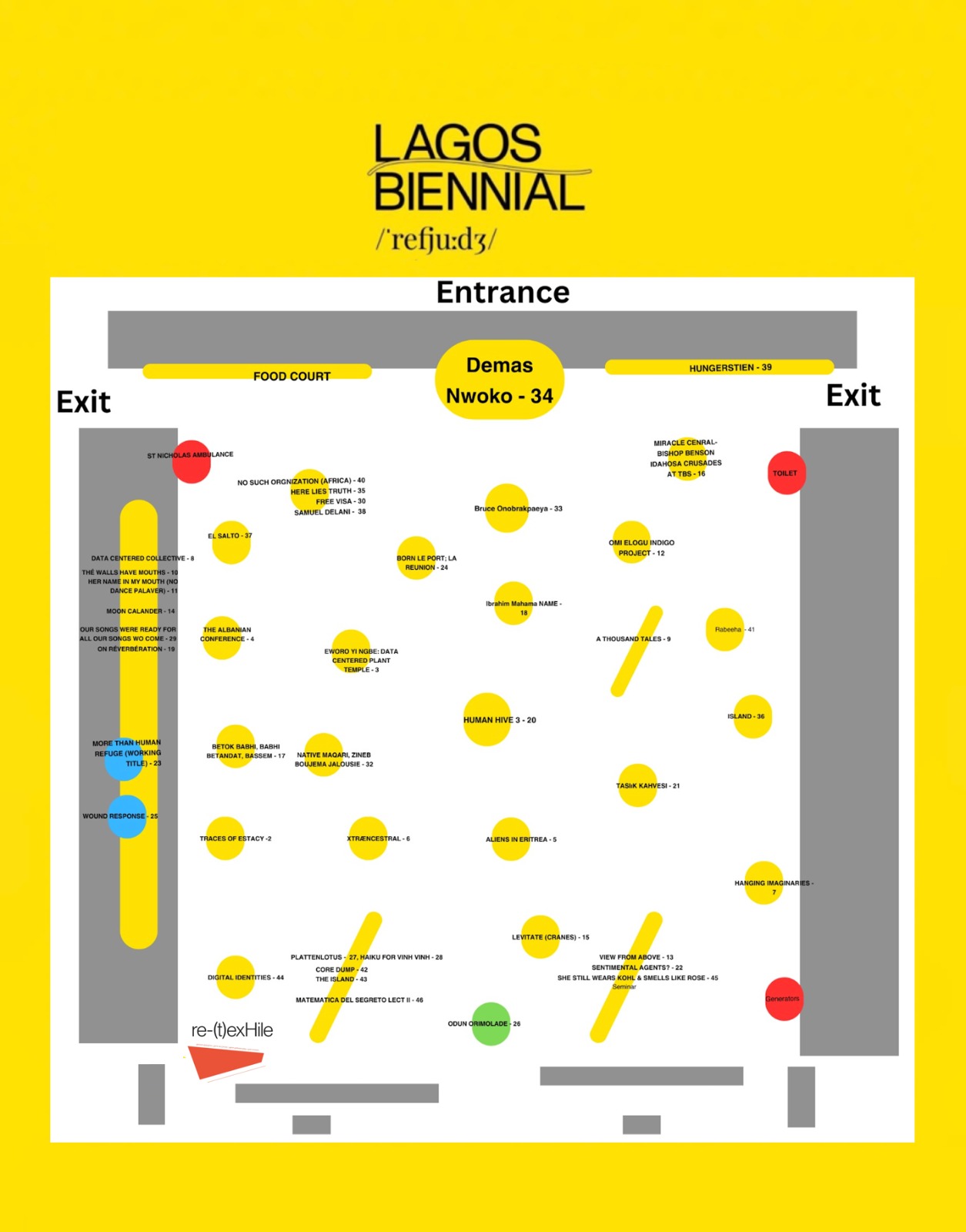
Re-(t)exHile, was presented at the 4th Lagos Biennial of Art and Architecture 2024, held in Tafawa Balewa Square — a former colonial racecourse transformed into a post-independence civic space. This historically charged site enabled a critical exploration of territory, sovereignty, belonging, and alliance, functioning as a symbolic node from which to rethink the biennial format. Curated by Folakunle Oshun and Kathryn Weir, the exhibition deliberately moves away from conventional display models to explore open, processual forms where the artwork is not an endpoint but a generative gesture. Within this framework, LAPIEZA participates with the relational installation re-(t)exHile, a project that investigates the environmental and geopolitical impact of global textile waste in Africa and its circulation as postcolonial commodity. Tthe piece unfolds through found materials, migrant textiles and ephemeral architectures, weaving together poetic and critical threads around exile, refuge, and repair. Artists including Martinka Bobrikova, Óscar De Carmen, Adebola Badmus, and María Alejandra Gatti contribute to this polyphonic intervention, in collaboration with Anto Lloveras. The project integrates prior field research in Lagos (2022–2023), visual essays, social media-based storytelling, and a photographic archive by Mide King, forming a living document that amplifies the work’s political and aesthetic layers. This Art Series is part of LAPIEZA’s long-standing commitment to expanded, situated, and relational art practices


Art as refuge

A glance at the 4th Lagos Biennial


The 2024 edition of the Lagos Biennial takes place in the heart of Lagos on the grounds of Tafawa Balewa Square, a site named in honour of the first Nigerian Prime Minister. The Biennial occupies this historical space, linked to entertainment in the colonial period as a racecourse and to political, cultural and commercial events after Independence, in order to reflect on its possible meanings in relation to political allegiance, territory, sovereignty, regionality, notions of belonging, encounter, and alliance. It moves the cursor away from a history of ‘universal’ exhibitions and biennials towards experiments in non-conventional modes of exhibition making, shifting from the idea of the work as an end in itself towards generative models and prototypes that continue to activate possibilities in the world.


CURATED BY 
FOLAKUNLE OSHUN AND KATHRYN WEIR


PHOTOS BY MIDE KING


IV Art and Architecture BIENNIAL ________ Lagos, Nigeria 2024 __________TEXTILE PAVILION


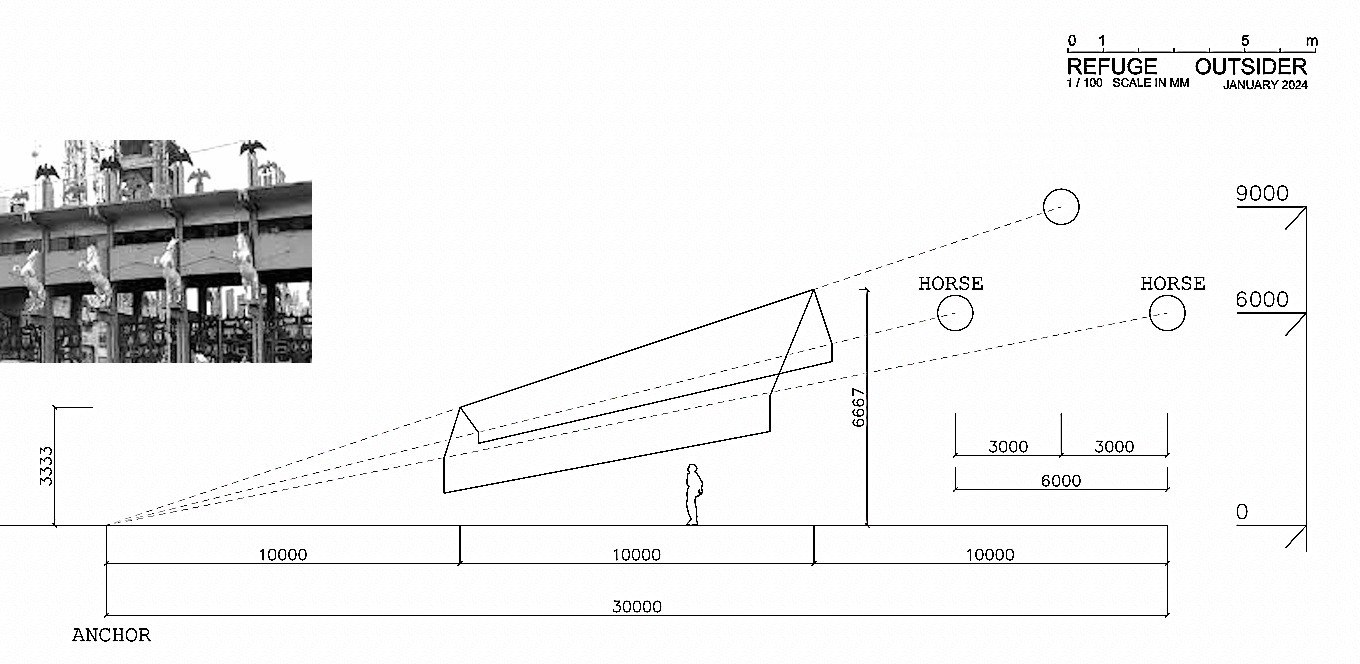
The OUTSIDER team's participation in the Biennale technically consists of the construction of a textile pavilion in the square, anchored to the sculptures in the shape of horses and eagles that are at the top of the entrance. The pavilion is made up of tension cables anchored to the sculptures and a spike to which these cables are anchored. This installation is carried out by the technical arm of LaBienal to guarantee stability and anchoring with the associated engineer. Before and during the Biennale, the OUTSIDER team will coordinate training on these cables of a cover, made up of textile scraps purchased at the Kataangwa market. Several bundles will be purchased, which will be analyzed in the workshop, and will be sewn on-site to form the textile cover (jaima-flag concept), which will increase in size during the biennial, with the artists working on its creation, counting with the participation of the attending public. The pavilion is built together, but it is never finished. Whoever wants to sew a part. Being outdoors, weather conditions, wind or rain, can be agents that intervene in the process. Being a symbolic cover, a piece of fabric sewn with another, even with the utmost rigor, the impermeability of the cover seems secondary, and it can get wet and dry in the sun. The cover fragments will be sewn and securely consolidated to the guy wires. The perimeter of each piece that makes up the awning must necessarily be self-supporting and resistant so that its own weight does not open the seams. The sum of fragments consolidates the cover, which is considered as a process, a fragment of a greater possibility. The disassembly and transfer will take place once the public part of the Biennial is over. Some relevant pieces, the most successful, will be packaged for later use in other contexts. Repatriated and traveling mini-pavilions.

A team of four people will travel to Lagos, Nigeria on January 15, 2024, to prepare the OUTSIDER project at the 4th Art and Architecture Biennial, to be held in Tawafa Balewa Square, along with eleven other participating teams. The biennial is held outdoors and is made up of twelve pavilions different in concept and form, which are united by the premise of curating, in relation to the concept of REFUGE. Global museography or micro-urbanism, fair or expo type, is carried out by AKETÉ and its associates. The official opening is on February 3 and the Biennial will last a week.


KITCHEN DIALOGUES - WE CAME TO HAVE DINNER WITH STRANGERS - 2013


LLLL ART AGENCY

AT
RAKE CONSTANT DECAY
TRONDHEIM NORWAY 11.10.2013
CONVERSATION AS ART
DINNER AS ART, 11

http://kitchendialogues.com


> 
Martinka and Oscar, artists and hosts. Four bright and smart students from NTNU. Øyvind and his two lovely teenage daughters. LLLL Art Agency

Upon arrival we have quick conversations with everyone. The test. The mood checkout, excellent. Oscar moves fast in the kitchen while martinka throws her charm. At the table the generous wine brought by the students opens a delicious mood. As we eat the salad we talk about the roads, the weather and the inmigration, commonplaces. With some wine and the main dish we talk with the students about possible tv shows we can make. In the dessert we talk about art, about us being part of the artpiece, being the spectators of our own play, where the artist direct a scenography where each one plays his own rol. To play a rol is charming, since you have to give and listen, be active and patient. The contextual relational pieces always demands an extra effort in the audience.

To play with context is a crispy idea in art, we do not have to talk about dada. Dada speaks alone. Dieter Roth knew about this. Daniel Spoerri knew about this. Rirkrit Tiravanija knew about this and Antonio Miralda knows pretty well about this. 

We know as well, since we love the brightness of the contemporarity and the references to some masters of context symphonies. We loved to meet all the guests and to be able to talk and develop certain intimacy with the artists after dinner, chilling at a couch and by the fire. Thats the ultimate goal of the piece, to generat the confort zone that enables us to make a further step.

So, there is the context frame, Rake, the sub frame, The Kitchen Dialogues, and our own frame, the upcoming FROZEN HEAT SERIES.


At the back entrance we look into the mirror. Self reflection upon rival, we welcome ourselves to the decay. We take some shots of us as part of the decay mood. We came around again to have dinner. We enjoy the idea of spending some time chatting with strangers. Upon the arrival we can feel the programers are delivering new ideas to the building. The fireplace at the entrance lobby space gives a feeling of intense cozyness, and the wooden bench works as perfect usable installation. Some spaces are receiving a generous by-pass by ART. We actually came to have dinner with strangers. To have dinner as art, and yes, we had great dinner. > kitchen dialogues –http://kitchendialogues.com/


site
context
old fabrics
mood process
curatorial
decay
art 


KITCHEN DIALOGUES / RAKE CONSTANT DECAY 2013


WE LOVE THE EXCELLENCE OF THE FOOD
AND
THE SWEET ENVIRONMENT
YET ANOTHER TIME

THE DECAY HAS WORKED OUT FOR US
WE CAME WEEK AFTER WEEK
TO ENJOY THE ART

TO SIT BY THE FIRE AND HAVE SOME WINE
AND
TO TALK TO STRANGERS WHILE WE EAT


RELATED VITAMIN 034 (I/-) 


La diferencia entre los artistas que producen obras a partir de objetos ya producidos y los que actúan ex nihilo es la que percibía Karl Marx en La ideología alemana entre "los instrumentos de producción naturales" (el trabajo de la tierra, por ejemplo) y "los instrumentos de producción creados por la civilización". En el primer caso, prosigue Marx, los individuos están subordinados a la naturaleza. En el segundo caso, están en relación con un "producto del trabajo", es decir, con el capital, mezcla de labor acumulada e instrumentos de producción. Entonces "no se mantienen unidos sino por el intercambio", un comercio interhumano encarnado por un tercer término, el dinero. El arte del siglo veinte se desarrolla siguiendo un esquema análogo; la Revolución Industrial hace sentir sus efectos pero con retraso. Cuando Marcel Duchamp expone en 1914 un portabotellas y utiliza como "instrumento de producción" un objeto fabricado en serie, traslada a la esfera del arte el proceso capitalista de producción (trabajar a partir del trabajo acumulado) basando el papel del artista en el mundo de los intercambios: se emparenta de pronto con el comerciante cuyo trabajo consiste en desplazar un producto de un sitio a otro.

El uso de las formas
Nicholas Bourriaud