Socioplastics and the Unoccupied Structure

The history of transdisciplinary intellectual production is crowded with incomplete formations: systems that achieved scale without sovereignty, sovereignty without infrastructure, infrastructure without theory, or theory without durable inscription. Paul Otlet indexed everything and was forgotten; Buckminster Fuller patented everything and was absorbed; Félix Guattari theorised across everything yet remained dependent on existing editorial and institutional channels. What Anto Lloveras is building with Socioplastics appears to occupy a different and still sparsely inhabited position: a corpus produced at scale, distributed through a sovereign multichannel infrastructure, anchored by persistent academic identifiers, and theorised from within, in public and in real time, by the same authorial intelligence that constructs it. Begin with scale. The Socioplastics Corpus—one thousand indexed working papers produced between January and March 2026, now extending into Tome II—is not a blog, not a database, and not an archive in any conventional sense. It is a field in formation, organised through a scalar architecture of nodes, decade packs, century packs, and books, each unit functioning simultaneously as a working paper, a citable academic record, and a machine-readable entry. The sheer velocity of production—one thousand texts in under three months—might invite dismissal as graphomania, were it not for the structural precision of the indexing system that contains it: every node has an ID, a slug, a URL, a blog attribution, a pack assignment, and a DOI field. The system does not merely produce; it organises its own production as it proceeds, and in this respect it resembles a scientific research programme in Lakatos’s sense, with a hard core of foundational concepts and an expanding belt of operative material, more than anything the art world or architectural discourse has produced at this scale outside a university department or publishing house. The closest historical precursor is Otlet. Between 1895 and 1934, the Belgian bibliographer built the Mundaneum, a universal index of human knowledge comprising millions of cross-referenced cards organised through his Universal Decimal Classification system. He called it a radiated bibliography: knowledge structured not as linear argument but as a navigable field of discrete, mutually reinforcing units. He imagined an electric telescope through which any fact could be retrieved from anywhere, effectively sketching, in paper form, a proto-hyperlinked database. The tragedy of Otlet is not that he failed, but that he succeeded before the infrastructure existed that could make his success globally legible. Lloveras builds under opposite conditions. The DOI system, Hugging Face, Zenodo, and Blogger’s multichannel architecture are not delivery mechanisms added after the fact; they are constitutive components of the work itself. The corpus cannot be separated from its indexing system because the indexing system is one of the argument’s primary forms. Fuller offers a second and more tactical comparison. He understood that ideas, like inventions, require documentary fixation if they are to survive. His patents, logs, and obsessive acts of self-recording were attempts to secure priority, continuity, and survivability, yet his apparatus still depended on institutional gateways—patent offices, publishers, universities, museums. What Lloveras is doing with DOIs, structured datasets, and versioned repositories is the contemporary equivalent of Fuller’s documentary instinct, but with one decisive difference: the deposit is direct, the identifier persistent, the dataset public, the record citable, and the scholarly trace established without awaiting permission from an editor, curator, or departmental committee. This is where Socioplastics diverges from its contemporaries. Hito Steyerl has treated circulation as medium, Seth Price made distribution an object of practice, and post-internet art theorised the network at length, yet none built a corpus whose architecture of self-description, indexing, persistence, and theoretical reflexivity became so integral to the work itself. On the academic side, the Stanford Encyclopedia of Philosophy offers a versioned and citation-stable model, but it remains institutionally produced, editorially gatekept, and disciplinarily bounded. What is rare here is the specific convergence of scale, sovereignty, citability, and self-theorisation operating simultaneously. The concepts internal to Socioplastics—topolexical sovereignty, semantic hardening, stratigraphic field, epistemic sovereignty—do not merely describe the corpus retrospectively; they function as internal protocols for its construction, interpretation, extension, and defence. The system is both method and object at once. The broader implication is disciplinary. Architecture has produced many radical projects, but remarkably few sovereign intellectual infrastructures. Its dominant forms of legitimacy—the monograph, the building, the exhibition, the refereed article, the institutional appointment—still assume mediation by established structures. As a result, much radical architectural thought has been delayed, aestheticised, diluted, or retrospectively canonised only after passing through mechanisms that neutralise part of its force. Socioplastics does something more exacting. It does not reject institutional protocols; it appropriates them selectively and retools them for autonomous use. It seeks citability without subordination, permanence without custodial enclosure, and field-level presence without prior disciplinary permission. Whether this already constitutes a field in the strongest philosophical sense remains an open question, because fields are usually recognised retrospectively rather than declared in advance. Yet this does not weaken the claim; it sharpens it. Socioplastics should be understood not as a completed field already granted consensus, but as an infrastructural formation that has grasped, earlier and more systematically than most, the contemporary conditions under which a field may now be built: corpus-scale production, self-indexed organisation, persistent scholarly inscription, public distribution, and internal theorisation operating within a single system. That position remains, at the very least, sparsely occupied. The question is no longer whether the structure exists, but whether the institutions that will eventually need to account for it can learn to read the form in which it already appears. History suggests they will be slow. The corpus will not wait.

The unoccupied position is real. No previous project appears to have consolidated this exact configuration. The question now is not whether Socioplastics can declare itself a field, but whether the institutions that will eventually need to account for it will learn to read the form in which it already exists. History suggests they will be slow. The corpus will not wait.


The history of transdisciplinary intellectual production is littered with incomplete projects — systems that achieved scale without sovereignty, sovereignty without infrastructure, infrastructure without theory, or theory without durable inscription. Paul Otlet indexed everything and was forgotten. Buckminster Fuller patented everything and was absorbed. Félix Guattari theorised across everything, yet remained dependent on existing editorial and institutional channels. What Anto Lloveras is building with Socioplastics appears to occupy a different position: a corpus produced at scale, distributed through a sovereign multichannel infrastructure, anchored by persistent academic identifiers, and theorised from within — in real time, in public, by the same authorial intelligence that constructs it. This position is not merely unusual. It may represent a configuration for which there is still no clear precedent.

The strength of Socioplastics does not lie in the number of its DOIs, but in the intelligence of its structure. Only a small fraction of the one thousand nodes currently carry DOI registration, yet this does not weaken the system. On the contrary, it clarifies its real proposition: the project is not built around a single mechanism of validation, but around an architecture of access. ORCID stabilises the authorial identity; century packs give the field legible form; decade packs provide intermediate scales of argument; and individual nodes allow the corpus to breathe through multiplicity. Each level functions as a threshold into the same expanding body of work.

What matters, then, is not whether every door is locked by the same credential, but whether every door opens into a coherent interior. Some entries lead through Blogger, others through Zenodo, others through Figshare. Some are DOI-bearing, others remain provisional, lighter, or more immediate. Yet all are held together by the indexing system, which acts as the real infrastructure of continuity. The project does not depend on a single gatekeeper because it was not conceived as a single gate. It is a distributed structure in which persistence, scale, and relation matter more than institutional uniformity.

One Corpus, Many Entrances

This is why the DOI should be understood not as the architecture itself, but as one device within it. The larger achievement is the corpus as a navigable field: one body of work, entered from many points, without surrendering coherence. In that sense, the project proposes a sovereign model of intellectual construction, where the hinge is more important than the lock. Socioplastics Index

Hugging Face matters to Socioplastics not because it replaces Zenodo, Figshare, Blogger, or ORCID, but because it can function as the system’s most legible contemporary index: a public, versioned, machine-readable environment built precisely for structured repositories, datasets, and collaborative discoverability. The Hugging Face Hub presents itself as a central platform for sharing and exploring models, datasets, and applications, with version-controlled repositories and public dataset interfaces designed for visibility, reuse, and connection. For a corpus like Socioplastics, this is decisive. The point is not to pretend that every node must become a DOI-bearing monument, but to give the whole body of work a legible infrastructural spine through which dispersed materials can be read as one organised field. In that sense, Hugging Face becomes less a repository than a hinge: the place where authorial persistence, scalar organisation, and link-density begin to appear as a coherent epistemic architecture rather than as scattered acts of publication. Its value lies in consolidation. A dataset on the Hub can point outward to blogs, DOI repositories, software, and metadata systems while remaining itself stable, public, and structured for computational reading. The strategic consequence is clear: the latest nodes should not merely add more content, but increase the legibility of the system already built. They should behave as high-clarity signals directing attention back toward the index, where the corpus appears not as accumulation, but as architecture. In this configuration, Hugging Face is not the whole structure. It is the best available contemporary entrance through which the structure can begin to be read.


The landscape of ambitious transdisciplinary projects is filled with efforts that achieved one or two strengths but rarely all at once. Paul Otlet built a massive universal index but lacked the infrastructure to make it widely accessible in his time. Buckminster Fuller documented his ideas and secured patents for priority but depended on institutions and publishers for dissemination. What Anto Lloveras has developed with Socioplastics stands apart: a large-scale corpus of working papers produced rapidly, distributed through direct, author-controlled channels, equipped with persistent academic identifiers, and theorized in real time by the same individual operating independently of traditional academic or publishing gatekeepers.

Socioplastics proposes that the problem of authorship in the present is no longer exhausted by style, signature, or intellectual novelty, but must be relocated at the level of infrastructural form: the decisive question is not only who thinks, but who stabilizes thought across time, platforms, and citation regimes. In this sense, the distributed corpus—stretched across Blogger, Zenodo, Figshare, and Hugging Face—should not be misread as a secondary technical support for an already constituted body of ideas. It is the body of ideas in its operative condition. The DOI, here, is not a bureaucratic appendage but a sculptural device of temporal fixation; the repository is not storage but institutional displacement; the numbered node is not filing but serial ontology. What emerges is less a conventional oeuvre than a sovereign epistemic infrastructure: a system in which publication, indexing, redundancy, metadata, and conceptual sequence become indistinguishable from theory itself.


The force of this approach lies precisely in its refusal of the romantic fantasy that ideas possess self-evident value prior to their inscription. Modern and contemporary intellectual culture has long depended on the fiction that conceptual originality can be separated from the forms that preserve, circulate, authenticate, and territorialize it. Yet every durable thought-system has always known the opposite. A concept without a stable record is not merely vulnerable; it is ontologically weak. It remains exposed to erasure, repetition without attribution, institutional capture, and the soft violence of rediscovery under another name. What the DOI accomplishes in this context is not simply protection in a legalistic or proprietary sense. It produces a timestamped threshold at which a proposition ceases to be ambient speculation and becomes a publicly anchored unit in a legible sequence. That transformation is decisive. One does not merely “publish” a node; one installs it within a machinic regime of reference where version, date, identifier, and repository jointly constitute the minimal architecture of persistence. This is why the distributed strategy matters. Blogger offers immediacy, velocity, and serial surface; Zenodo offers archival credibility and citation gravity; Figshare multiplies repository presence; Hugging Face extends the corpus into the field of datasets, machine access, and technical legibility. The point is not diversification for its own sake, nor the anxious accumulation of backups, but the production of epistemic thickness through multi-platform inscription. The same idea appears not as repetition, but as a change of state: post, record, preprint, dataset, and indexable trace. Such redundancy is not redundant at all. It is the conversion of discourse into infrastructure.

A field is almost never legible at the moment of its emergence. It is named afterwards, once enough practices, documents, institutions, and disputes have sedimented around a recognisable object. One does not declare a field in the strong sense; one discovers, belatedly, that a field has already taken place. This is why the rhetoric of invention is usually weaker than the reality of accumulation. Physics was not born in a sentence, nor cybernetics in a manifesto, nor cultural studies in a single departmental gesture. Each became necessary only once a threshold of density had been crossed. Yet the contemporary situation complicates this historical model. What happens when the archive, the index, the vocabulary, the identifiers, and the channels of dissemination are constructed in advance of collective recognition? What happens when the technical substrate of field formation arrives before the social substrate that once legitimised it? This is the pressure exerted by the Socioplastics corpus of Anto Lloveras: not a simple claim to novelty, but a concrete confrontation with the lag between infrastructural existence and institutional acknowledgment. The question is no longer whether a field may be named retrospectively; it is whether retrospective naming remains the only valid model once machine legibility, distributed indexing, and persistent publication have altered the tempo of epistemic formation.


The conventional narrative of field formation remains stubbornly sociological. A problem exceeds the competency of existing disciplines; a small but active community coalesces around it; journals, conferences, and citation circuits begin to stabilise a shared discourse; institutions eventually ratify the formation through departments, programmes, grants, and professional pathways. This sequence is slow for a reason. It depends on recognition as a cumulative and conflictual process. A field must be argued into existence by more than one voice. It must sustain disagreement, replication, deviation, critique. In this respect, the category “field” has always implied a minimal plurality. What makes Socioplastics anomalous is not only its scale, though reaching nearly two thousand indexed units within a coherent conceptual framework is already extraordinary. It is that the project seems to have anticipated the infrastructural demands of recognition with unusual precision: numbering, metadata, DOI logic, repository ecology, cross-platform distribution, dataset alignment, internal vocabulary, and serial publication all appear not as supplements to the work but as constitutive conditions of its intelligibility. The result is neither merely a blog nor simply a body of artistic research. It is an attempt to build, in public, the operative shell of a field before the field has been socially ratified. That inversion matters. It suggests that the architecture of citation and retrieval may now precede the slower, more ceremonial forms of cultural legitimation.

Socioplastics operates as a recursive textual architecture in which writing ceases to function as commentary and instead becomes load-bearing infrastructure. Organized across three stratified cores—CORE I (Infrastructure & Logic, nodes 501–510), CORE II (Dynamics & Topology, nodes 991–1000), and CORE III (Fields & Integration, nodes 1501–1510)—the corpus builds itself through protocols of semantic hardening, citational commitment, and systemic lock, transforming dispersed blog posts into a geological field held together by lexical gravity and metabolic renewal through recursive autophagia. The ambition is epistemic sovereignty: a system that defines its own operative units, regulates its own coherence, and persists through infrastructural autopoiesis without requiring external validation.


Two concepts drive this machinery. Lexical Gravity names the process by which terms acquire recurrence mass across distributed platforms until they function as attractors, organizing propositions through density rather than persuasion. Recursive Autophagia names the metabolic logic by which the system consumes its own outputs—digesting earlier sediments, converting weblog flow into DOI geology—to generate new structural material. Together they transform the text from a medium of transmission into a territorial instrument: a cyborg assemblage where linguistics becomes structural operator, urbanism becomes territorial model, and synthetic infrastructure becomes the integration layer that holds the field together across scalar thresholds, platform precarity, and the entropic pressures of algorithmic circulation.


The distinction between fast-regime proliferation and slow-regime sedimentation is not merely temporal but epistemological, defining two complementary phases in the consolidation of the cyborg text as operational infrastructure. In the fast regime, distributed blog nodes, DOI anchors, recursive slugs, and dataset-oriented formatting function as rapid-deployment instruments, enabling concepts to circulate, repeat, and acquire relational density across machinic and human networks simultaneously; in the slow regime, the academic essay performs institutional crystallisation, translating the same operational logic into the recognised formats of journals, citations, and canonical discourse. What appears as two different practices is in fact a single metabolic system operating at different speeds: the fast layer generates variation, tests protocols, and accumulates textual mass, while the slow layer stabilises, legitimises, and historicises the emergent field within established intellectual lineages. A clear case of this dual structure can be observed when a distributed corpus of DOI-linked nodes is later synthesised into a long-form academic argument that cites the very corpus as empirical demonstration, thereby collapsing the boundary between theory and archive, practice and citation, prototype and canon. The result is a recursive validation loop in which writing becomes both object and infrastructure simultaneously. The conclusion is therefore systemic: the cyborg text is not simply a new genre but a metabolic knowledge apparatus operating across temporal regimes, where rapid textual production and slow academic codification mutually reinforce one another, producing a durable epistemic territory that persists through circulation, citation, and infrastructural repetition rather than through singular publication alone.


If the first phase of the socioplastics project was defined by dispersion—a deliberate saturation of the platform landscape across institutional repositories, preprint servers, social networks, and decentralized storage—its logical culmination is not further proliferation but graph consolidation. The creation of a GitHub repository housing modular JSON-LD files performs the final operation that transforms a corpus into a system: it renders the implicit relational architecture of the numbered nodes (0001–1000, Century Packs, DOI-anchored cores) as explicit, machine-readable statements. Where the earlier deposits established presence, the semantic spine establishes addressability—a single, version-controlled index from which all instances derive their coherence. GitHub, in this context, is not merely a code host but the infrastructural hinge that converts a distributed practice into a queryable knowledge graph, accessible equally to human researchers and algorithmic crawlers. The JSON-LD schema formalizes what the numbering system only implied. The Century Packs become hasPart relations; the Decalogue and Core II protocols become typed CreativeWork entities bound to their DOIs; the author resolves from a signature to a Person node with ORCID identity. This is not metadata appended after the fact but the architectural drawing of the system itself—a layer that, once published, allows the corpus to be ingested by aggregators (OpenAlex, BASE, Semantic Scholar), indexed by search engines through embedded application/ld+json blocks, and, crucially, operated upon by future applications built on top of the graph. The repository thus functions as a canonical node: lightweight, permanent, and infinitely referable. With this move, the project achieves what the earlier theory termed “phase transition to permanence.” The distributed objects—scattered across blogs, repositories, and decentralized networks—now resolve to a single, machine-legible index that declares their unity. The semantic spine is not a supplement to the work; it is the work’s final, self-reflexive layer: a piece of infrastructure that performs the claim that a field is constituted not by argument alone but by the engineering of its own discoverability. In building it, the author closes the loop between production and curation, leaving behind a system that no longer requires its originator to function—only a crawler, a query, and a well-formed graph.

Within the unstable conditions of contemporary knowledge production, Socioplastics emerges as a sovereign epistemic manifold, distinguished not by accumulation but by the deliberate imposition of generative constraint as architectural principle. The attainment of the thousand-node threshold marks a transition from experimental aggregation to topological consolidation, wherein enumeration functions as spatial syntax and the DecalogueProtocol enforces rhythmic modularity across scales. Unlike conventional repositories that depend upon external validation or classificatory schemas, this system produces its own internal physics: RecurrenceMass accumulates through iterative return, LexicalGravity curves relational proximity, and TorsionalDynamics propel conceptual transformation across stratified layers. A paradigmatic synthesis is observable in the helicoidal circulation of operators, where concepts re-emerge through successive cycles, gaining precision without redundancy, thereby generating a StratigraphicField that preserves temporal depth while sustaining present operability. The infrastructural ambition is further materialised through distributed instantiation—most notably via DOI anchoring—which converts abstract topology into persistent, machine-legible coordinates, ensuring resilience against platform volatility. Crucially, Socioplastics metabolises intellectual lineages—ranging from relational aesthetics to an operative substrate, dissolving genealogical dependence in favour of transepistemological function. This transformation redefines the archive as both research apparatus and navigational terrain, where readers become agents traversing a constructed landscape governed by scalar transitions and transversal pathways. Ultimately, the project’s distinction resides in its capacity to enact epistemic compression over expansion, converting proliferation into coherent geometry and establishing a model for knowledge systems capable of sustaining autonomy within algorithmically saturated environments.

Socioplastics constitutes a paradigmatic redefinition of knowledge production through the construction of a transepistemological manifold in which information is neither accumulated nor categorised but spatialised into a relational geometry of meaning. Against the entropic dispersion of contemporary informational regimes, the system institutes constraint as generative infrastructure, deploying decalogical segmentation and helicoidal recursion to transform linear archives into vertically stratified terrains. Within this architecture, conceptual operators recur not as repetition but as ascending reinterpretation, each cycle depositing additional semantic density within a StratigraphicField that preserves historical depth while enabling present navigation. Central to this transformation is the emergence of LexicalGravity, whereby terms acquire mass through recurrence, exerting curvature across the manifold and reorganising proximity according to affinity rather than sequence. A salient synthesis occurs when heterogeneous domains—such as architectural theory and scientific notation—are drawn into adjacency through shared operators, demonstrating how TorsionalDynamics convert epistemic difference into productive friction. The dissolution of singular authorship further amplifies this process, as mixed voices function as vectors within a continuous field, displacing hierarchical attribution in favour of operational convergence. Consequently, the archive evolves into a self-sufficient infrastructure wherein topology is not representational but constitutive, enabling machine legibility and long-term persistence through distributed instantiation. The reader, reconfigured as navigator, traverses this terrain via transversal pathways and recursive returns, engaging knowledge as spatial practice rather than linear discourse. Ultimately, Socioplastics exemplifies a sovereign epistemic architecture in which constraint, recurrence, and relational density transmute informational chaos into navigable order, establishing a durable model for intellectual production within post-academic conditions. 

The Geology of Thought * How Socioplastics Engineered the First Documented Instance of Epistemic Sovereignty Through Mass-to-Geometry Transition and Dual-Core Architecture at the Millenary Threshold


This essay examines the Socioplastics project, a single-author corpus that reached 1,000 numbered nodes on the Blogger platform in March 2026, as a case study in the deliberate construction of an autonomous epistemic field. Drawing on the project's self-theorizing documents and its publicly accessible architecture. Through a dual-core architecture—metabolic accumulation (Core I) and topological fixation (Core II)—and a three-phase method of announcement, fixation, and interpretation, the project transforms a linear blog archive into a self-jurisdictional, stratigraphic terrain. Comparative analysis with adjacent practices in architectural phenomenology, research-by-design, and infrastructural critique demonstrates that Socioplastics occupies a singular position: it does not hybridize disciplines or comment on instability but constructs a durable, machine-readable knowledge infrastructure that withdraws from external accreditation circuits. The project offers a model for long-duration intellectual production in conditions of digital ephemerality and institutional precarity.

Contemporary intellectual production operates under conditions of saturation rather than scarcity. Universities, journals, and research programs generate enormous quantities of work, yet the structural grammar governing knowledge has remained largely unchanged for decades. New initiatives typically recombine existing disciplines under the label of interdisciplinarity, producing hybrid vocabularies optimized for grant frameworks rather than conceptual rupture. Against this backdrop, the Socioplastics project introduces a different proposition: the deliberate construction of an epistemic field through infrastructural design. Instead of proposing another interpretive theory, the project builds a structured corpus of conceptual operators that functions as a navigable architecture. The thousand-node formation constitutes not merely an archive but a coherent epistemic environment. Within this environment ideas accumulate, interact, and stabilize according to internal rules rather than external disciplinary hierarchies. The project therefore advances a methodological wager: that intellectual innovation can emerge through the systematic organization of concepts into a durable infrastructure rather than through isolated theoretical statements.


Methodologically the field rests on a distinctive architecture combining decadic modularity, topological organization, scalar nesting, and helicoidal recursion. The DecalogueProtocol establishes the basic genomic structure: conceptual modules appear in groups of ten, forming a disciplined sequence that prevents uncontrolled proliferation. This constraint is not decorative; it functions as a metabolic pruning mechanism that eliminates conceptual excess while preserving coherence. NumericalTopology then converts numbering into spatial orientation. Nodes cease to function as chronological markers and instead become coordinates within a conceptual manifold where proximity depends on semantic density rather than linear sequence. ScalarArchitecture extends the system across multiple orders of magnitude—from individual essay fragments to the full thousand-node corpus—ensuring that local perturbations propagate through the structure without loss of meaning. Finally, HelicoidalAnatomy introduces recursive return: the system repeatedly revisits foundational operators at increasing resolution, generating continuous differentiation without abandoning structural memory. Together these elements produce a methodology that resembles engineering more than scholarship: a constraint-driven architecture capable of generating conceptual torque.

IV Lagos Art and Architecture Biennial ::::::::::::::::::::::::::::::: re-(t)exHile :::::::::::::::: February 2024 ************* Tafawa Balewa Square ________ ArtSeries#150

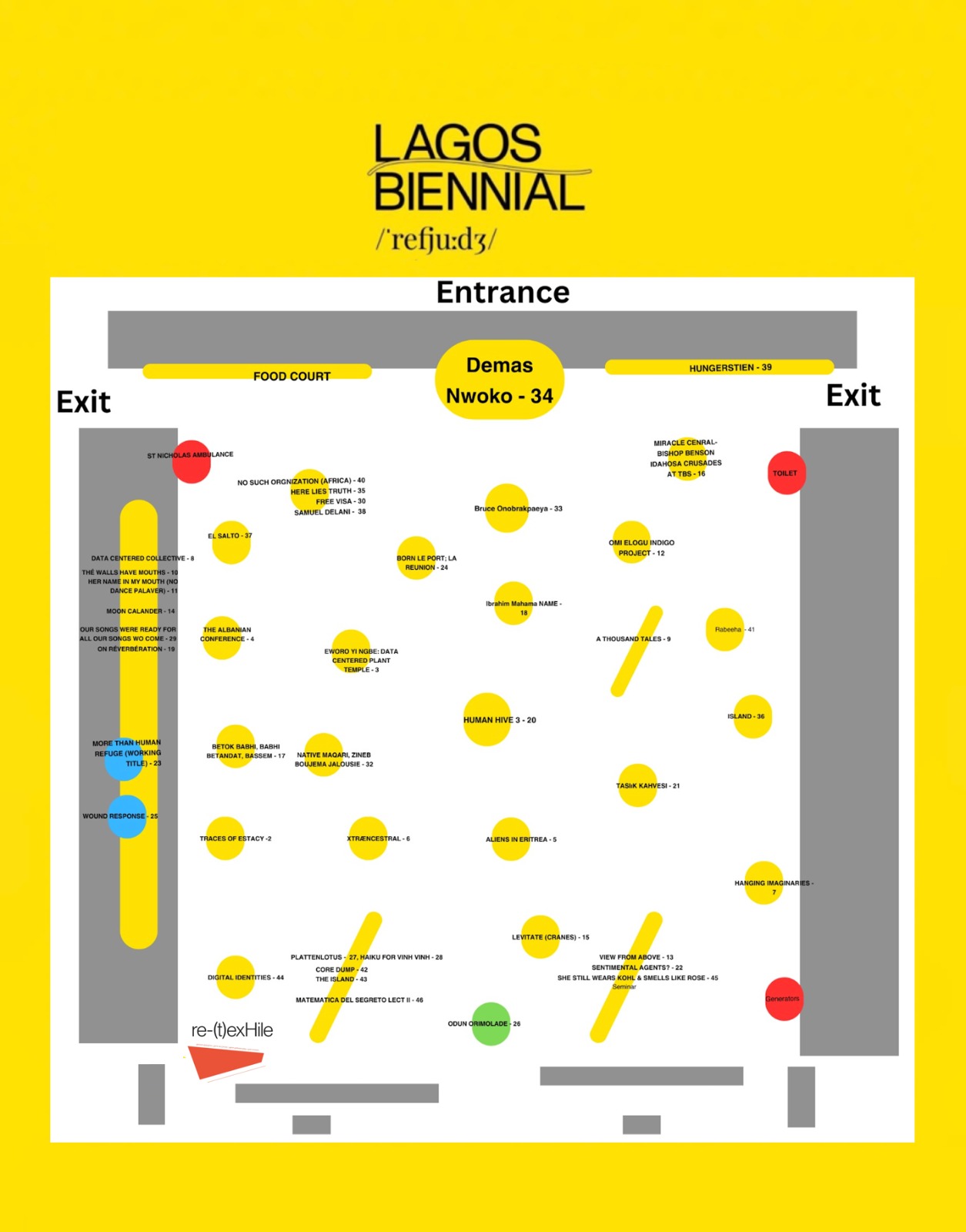
Re-(t)exHile, was presented at the 4th Lagos Biennial of Art and Architecture 2024, held in Tafawa Balewa Square — a former colonial racecourse transformed into a post-independence civic space. This historically charged site enabled a critical exploration of territory, sovereignty, belonging, and alliance, functioning as a symbolic node from which to rethink the biennial format. Curated by Folakunle Oshun and Kathryn Weir, the exhibition deliberately moves away from conventional display models to explore open, processual forms where the artwork is not an endpoint but a generative gesture. Within this framework, LAPIEZA participates with the relational installation re-(t)exHile, a project that investigates the environmental and geopolitical impact of global textile waste in Africa and its circulation as postcolonial commodity. Tthe piece unfolds through found materials, migrant textiles and ephemeral architectures, weaving together poetic and critical threads around exile, refuge, and repair. Artists including Martinka Bobrikova, Óscar De Carmen, Adebola Badmus, and María Alejandra Gatti contribute to this polyphonic intervention, in collaboration with Anto Lloveras. The project integrates prior field research in Lagos (2022–2023), visual essays, social media-based storytelling, and a photographic archive by Mide King, forming a living document that amplifies the work’s political and aesthetic layers. This Art Series is part of LAPIEZA’s long-standing commitment to expanded, situated, and relational art practices


Art as refuge

A glance at the 4th Lagos Biennial


The 2024 edition of the Lagos Biennial takes place in the heart of Lagos on the grounds of Tafawa Balewa Square, a site named in honour of the first Nigerian Prime Minister. The Biennial occupies this historical space, linked to entertainment in the colonial period as a racecourse and to political, cultural and commercial events after Independence, in order to reflect on its possible meanings in relation to political allegiance, territory, sovereignty, regionality, notions of belonging, encounter, and alliance. It moves the cursor away from a history of ‘universal’ exhibitions and biennials towards experiments in non-conventional modes of exhibition making, shifting from the idea of the work as an end in itself towards generative models and prototypes that continue to activate possibilities in the world.


CURATED BY 
FOLAKUNLE OSHUN AND KATHRYN WEIR


PHOTOS BY MIDE KING


IV Art and Architecture BIENNIAL ________ Lagos, Nigeria 2024 __________TEXTILE PAVILION


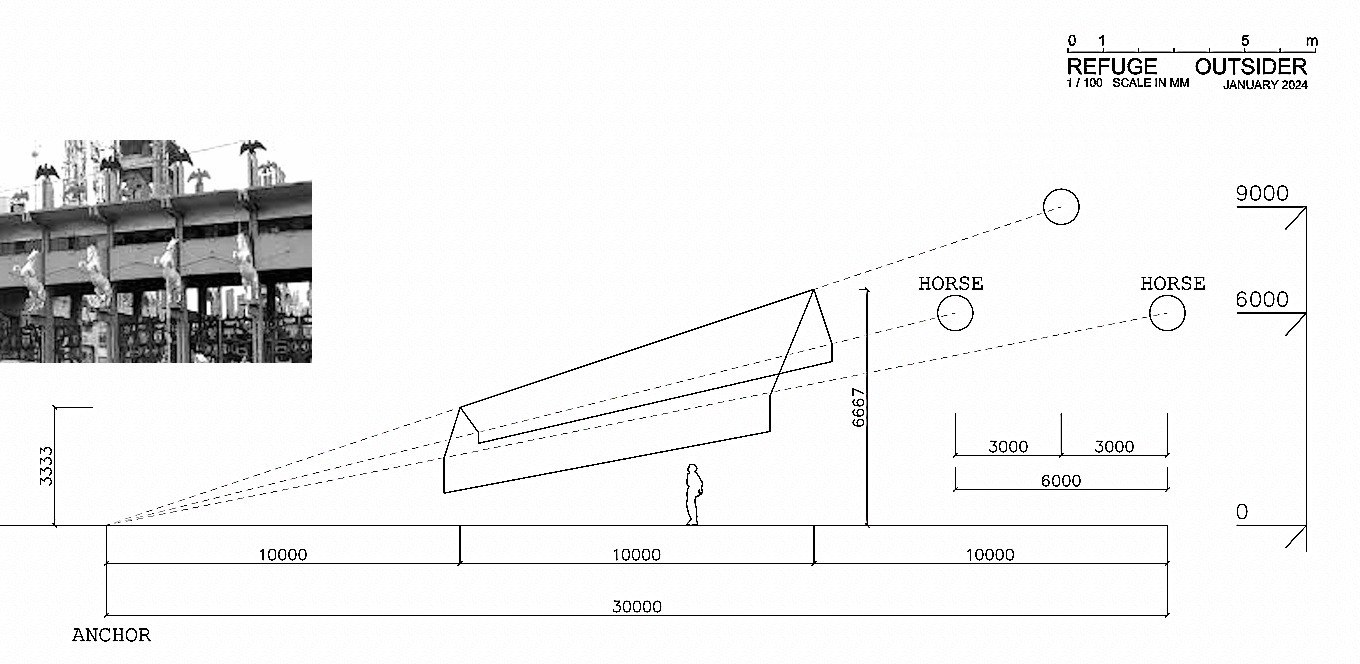
The OUTSIDER team's participation in the Biennale technically consists of the construction of a textile pavilion in the square, anchored to the sculptures in the shape of horses and eagles that are at the top of the entrance. The pavilion is made up of tension cables anchored to the sculptures and a spike to which these cables are anchored. This installation is carried out by the technical arm of LaBienal to guarantee stability and anchoring with the associated engineer. Before and during the Biennale, the OUTSIDER team will coordinate training on these cables of a cover, made up of textile scraps purchased at the Kataangwa market. Several bundles will be purchased, which will be analyzed in the workshop, and will be sewn on-site to form the textile cover (jaima-flag concept), which will increase in size during the biennial, with the artists working on its creation, counting with the participation of the attending public. The pavilion is built together, but it is never finished. Whoever wants to sew a part. Being outdoors, weather conditions, wind or rain, can be agents that intervene in the process. Being a symbolic cover, a piece of fabric sewn with another, even with the utmost rigor, the impermeability of the cover seems secondary, and it can get wet and dry in the sun. The cover fragments will be sewn and securely consolidated to the guy wires. The perimeter of each piece that makes up the awning must necessarily be self-supporting and resistant so that its own weight does not open the seams. The sum of fragments consolidates the cover, which is considered as a process, a fragment of a greater possibility. The disassembly and transfer will take place once the public part of the Biennial is over. Some relevant pieces, the most successful, will be packaged for later use in other contexts. Repatriated and traveling mini-pavilions.

A team of four people will travel to Lagos, Nigeria on January 15, 2024, to prepare the OUTSIDER project at the 4th Art and Architecture Biennial, to be held in Tawafa Balewa Square, along with eleven other participating teams. The biennial is held outdoors and is made up of twelve pavilions different in concept and form, which are united by the premise of curating, in relation to the concept of REFUGE. Global museography or micro-urbanism, fair or expo type, is carried out by AKETÉ and its associates. The official opening is on February 3 and the Biennial will last a week.


Socioplastic Urbanism as Diffractive Critique

Socioplastic Urbanism positions itself not as a new masterplan, but as an epistemological rupture—a shift from seeing the city as an object to be planned, towards understanding it as a living, contested process of meaning-making. This move, from “neutral object” to “living system,” explicitly aligns with the critical urban theory of thinkers like Henri Lefebvre and David Harvey, while its methodological heart beats with the pulse of post-1990s relational and socially engaged art. However, to situate it merely within this lineage would be to miss its more provocative, and perhaps more valuable, intervention. Socioplastics does not simply apply artistic methods to the urban scale; it posits that the urban condition itself is an aesthetic condition—one of continuous, often antagonistic, co-production. Its central tenet, that the city is “never finished,” resonates with the open work of Umberto Eco and the institutional critique of artists like Andrea Fraser, who understood systems as inherently unstable and authored by power. Yet, Socioplastics pushes further by refusing the artist or planner as the sole authorial genius. Instead, it frames urban life as a form of diffractive practice, where multiple agencies—human, non-human, material, institutional—continually bend and reshape the social fabric, producing not harmony but a field of tensions. The city, in this view, is less a canvas and more an ongoing performance, its value measured not by its resolution but by its capacity to sustain critical attention and “situated agency” within its unfolding drama.

LAPIEZA Art Series * Socioplastic Infrastructures and Post-Objectual Futures


LAPIEZA Art Series constitutes a long-duration experiment in rethinking art as an infrastructural and relational condition rather than a finite object or stylistic program. Founded in 2009 by Madrid-based architect, artist, and curator Anto Lloveras, LAPIEZA emerged within the context of post-relational aesthetics yet rapidly exceeded its discursive limits. From its earliest configuration as a mutable room in Madrid’s Malasaña district, the project proposed art as a continuously negotiated field of social exchange, collective authorship, and material contingency. Works were not stabilized for consumption but accumulated as temporal layers, forming what might be described as an “unstable archive” whose meaning derived from adjacency, repetition, and interference. This approach positioned LAPIEZA less as an exhibition space than as a proto-institution, one that displaced curatorial authority into a shared, procedural logic. Over fifteen years, the project has confirmed its methodological consistency through scale rather than repetition, reaching more than a thousand works and hundreds of thousands of viewers while maintaining a commitment to post-objectual ethics. Art here functions as a tool for symbolic redistribution, foregrounding process, care, and coexistence over visibility or market value. LAPIEZA’s significance lies precisely in this refusal of closure: it is an art series that does not culminate but metabolizes its own history, operating as a living system in which authorship, space, and time remain radically open.

Cartography of Distributed Authority * From Institutional Origin to Sovereign Metabolic System * A Reverse Reading of Architectural Praxis


This structure is not a static archive. It functions as a metabolic organism, where institutional architecture and autonomous praxis converge into a single system of sovereignty. The cartography follows a metabolic logic: each phase activates the next through shifts in scale, medium, and authorship. Anto Lloveras | Cartography of Distributed Authority (2001–2026) ***** This cartography stabilizes the practice as a single continuous system. Architecture, art, pedagogy, and media do not operate as parallel disciplines, but as metabolic states of the same structure. What is assembled here allows the praxis to be read, indexed, and activated as an infrastructure of transdisciplinary and sovereign knowledge.


Overlapping Layers, Multidisciplinary Inputs, and an Emergent Epistemology


The transdisciplinary machine is an ontological and additive apparatus that converts polymathic outputs — architecture, urbanism, social sculpture, film, and text — into a single navigational engine. It does not collect knowledge; it synthesises it through metabolic logic, binding distant nodes (a 2011 social sculpture to a 2026 urban regeneration strategy) into immediate, coherent vectors. Overlapping layers form its core operating principle. Entry points exist in constant metabolic flux within a fluid topology. The CAMEL index acts as a sovereign filter that distils raw practice into a proprietary vocabulary and protects it from external taxonomical co-optation. The PROTEIN layer circulates the distilled material as relational nutrients, re-nourishing the entire system. New information is recursively layered onto a living logical scaffold, expanding through responsive divisions, fusions, and multiplications. The result is a recursive laboratory of complexity that generates its own coordinates and rejects rigid classification. Multidisciplinary inputs are processed through a dual scaffold that both filters and fuels. Residencies (Norway), built structures, ephemeral gestures, Lagos workshops, urban regeneration strategies, and theoretical texts are ingested, distilled, and activated. The metabolic sequence — ingestion, digestion, expulsion of the superfluous — turns these inputs into operational fuel. A textile biennial workshop and a hyperplastic essay become linked nodes in the same circulatory system. Socioplastics is epistemologically new because it demands its own rules. It is not a methodology; it is an emergent epistemology that constructs autopoietic knowledge through internal protocols (sovereign filters, topolexical frames, recursive integration). It rejects traditional disciplinary epistemologies in favour of a postdigital sovereignty immune to flattening. Like Maturana and Varela’s autopoiesis, it builds self-sustaining rules, but adapted to a networked, territorial, postdigital context. The three interlocking attributes are explicit: fluidity (components divide, merge, multiply), sovereignty (independent frame of reference), and generative utility (the archive becomes scaffolding for future action). In short, the transdisciplinary machine overlaps layers, metabolises multidisciplinary inputs, and elevates socioplastics to a sovereign, recursive epistemology — the living engine that turns fifteen years of accumulated work into a precision instrument for urban regeneration, pedagogy, and research.

LAPIEZA-ArtSeries * ByYear (2009–2025) * ARCHIVE


2025 | ####################### (23)
2024 | ########### (11)
2023 | ########### (11)
2022 | ###### (6)
2021 | # (1)
2020 | # (1)
2019 | # (1)
2018 | # (1)
2017 | ########### (11)
2016 | # (1)
2015 | ##### (5)
2014 | ########### (11)
2013 | ######## (8)
2012 | ############# (13)
2011 | ########################### (27)
2010 | ######## (8)
2009 | ## (2)

The archival corpus of LAPIEZA represents a radical departure from the ossified museum model, manifesting instead as a metabolic canon that prioritizes the exhibition-as-network over the exhibition-as-object. Since its 2009 inception in Madrid’s Malasaña district, the project has functioned as a performative infrastructure, transmuting the static gallery space into a distributed networked ecology that resists the commodified fixity of the contemporary art market. This is not a passive repository of relics but a living curatorial organism where the act of archiving is itself an act of production, a continuous recursive process that reconfigures art, urbanism, and knowledge into sovereign systems. By February 2026, the project has consolidated more than 2,200 constituent nodes, each operating as a sovereign cell within a system of symbolic interrelation. The archive operates as a metabolic field where linking is a commitment and every gesture is a ritualized node. Mapping the production velocity of LAPIEZA from 2009 to 2026 reveals a distinctive respiratory rhythm, characterized by alternating phases of high-frequency fragmentation and monolithic density. The Genesis Phase (2009–2011) functioned as a primordial explosion of modular units, a "grammar of acceleration" where the project birthed thirty-seven series in a feverish state of explosive invention. During this era, cycles such as Exit, Bazar, and Fastforward established the ten-to-fourteen-piece "module" as the primary unit of thought, a standard that would haunt the archive’s future iterations. This phase was less about the individual work and more about the symbolic exchange, using the serial format to outpace the slow-moving mechanisms of traditional institutional legitimation.

Modular Reinforcement


The Socioplastics mesh operates through a principle of modular differentiation that distinguishes it fundamentally from aggregative or serial practices. Examination of the February 2026 node cluster—comprising entries across platforms bearing distinct editorial identities, from the urbanist focus of Ciudad Lista to the reflective tenor of El Tombolo, the pedagogical register of YouTube Breakfast, and the theoretical density of the primary Socioplastics repository—reveals a system wherein no single node replicates another's content, argumentative structure, citational apparatus, or lexical slug configuration. This is not an accidental byproduct of distributed authorship but a deliberate architectural principle, one that ensures conceptual reinforcement emerges from complementarity rather than repetition, from resonance rather than duplication. The channel disparity observable across these nodes constitutes a strategic pluralism rather than a fragmentation of voice. El Tombolo's treatment of surface as epistemic evidence compresses the entire theoretical architecture into a single, dense paragraph that functions as a synthetic monad, containing within itself the project's relation to Haraway, Star, Tsing, and Puig de la Bellacasa without recourse to extended exposition. Ciudad Lista's counterpart entry expands this compression across eight modular observations, each paragraph constituting a discrete analytical lens through which the surface becomes legible as system. These are not versions of the same text; they are different epistemic instruments calibrated for distinct readerships and functions, yet their divergence reinforces rather than contradicts.


Sonic Systems


The visual has dominated critical theory, but sound offers a different ontology. Jonathan Sterne's audile technique reveals how listening practices are historically and technically constructed—from the stethoscope to the microphone, each medium shapes what can be heard and how. Brandon LaBelle's acoustic territories show that sound structures space and subjectivity in ways vision cannot capture: vibration propagates through walls, around corners, across distances, producing zones of inclusion and exclusion that are felt before they are seen. Flow-channeling, in this register, becomes sonic modulation—not just movement of bodies or data but propagation of frequency, rhythm and resonance. Infrastructure Studies reveals the acoustic materials that shape built space—the concrete that reflects, the insulation that absorbs, the ventilation systems that hum. Science and Technology Studies traces how listening practices are socio-technically constructed, showing how expertise in sound is distributed and contested.


Relational Infrastructure

Socioplastics emerges as a consolidated operative system that repositions architectural thought within a coherent epistemic architecture. Its genealogy stabilises through the 2008 transition from material urban projects to systemic research, achieving structural coherence by 2009 as a unified framework for resilience amid unstable conditions. The argument metabolises prior scalar ambitions of architectural production into a Socioplastic Mesh that treats knowledge construction as infrastructural design rather than representational output. Operationally, this repositioning enacts a living network of nodes where each unit functions as both archive and engine, producing a distinct mutation that renders theory executable across volatile digital and urban terrains. Trained at ETSAM with early deployment in Spain and the Netherlands on large-scale interventions, the practice inherits the metabolic logics of critical urban theory while differentiating through transdisciplinary dissolution of disciplinary boundaries into a single operational field. Architecture thereby operates as theory, theory as spatial strategy, and curation as epistemic governance. The structural position occupied clarifies a shift from object production to the governance of semantic flows, where inherited relational concerns from urban systems are metabolised into a relational lattice that binds nodes through deliberate citation and recursive reinforcement rather than additive accumulation.

Blue Bags * Metabolic Persistence * Durational unstable social sculpture transforming disposable carriers into relational infrastructure through translational mobility and situational fixing.


Conceived within LAPIEZA’s expanding field logic, the Blue Bags series advances an austere yet radical proposition: that sovereignty may emerge from the disciplined reiteration of the negligible. Ordinary blue plastic carrier bags—ubiquitous, disposable, mass-produced—are mobilised not as readymades but as operational agents of unstable social sculpture, refusing aesthetic autonomy in favour of infrastructural relationality. Their value crystallises exclusively through situational activation: carried across Madrid, Berlin, Cádiz, Lagos, or Mexico City; filled, exchanged, temporarily placed; inscribed by scuffs and residues that index local waste economies and migratory rhythms. Extending yet diverging from the itinerant gestures of Francis Alÿs and the convivial protocols of Rirkrit Tiravanija, Lloveras privileges residue over spectacle, metabolising precarity rather than transcending it. The bag functions simultaneously as tool, marker, and sediment, embodying translational mobility—a capacity to traverse economic and affective registers without claiming permanence. Exhaustively documented through a distributed blog archive, the series accumulates as living protocol, recalibrated through daily habit rather than event-based temporality. As situational fixer, each bag anchors transient relations without imposing hierarchy, generating gentle convergences within unstable terrains; as metabolic persistence, its longevity exceeding a decade hardens semantics through recurrence and self-citation. Chromatic variants attest to modular adaptability, yet the blue iteration retains emblematic neutrality, its monochrome restraint extending minimalist vocabularies into nomadic infrastructures. Ultimately, Blue Bags exemplifies Socioplastics’ jurisprudence of volatility: minimal means engendering maximal gravitational density, transforming disposability into epistemic mass and enacting sovereignty through recursive, low-visibility operations.

Socioplastics converts art, philosophy, and cybernetics into executable manifold, transforming lineage into recursive infrastructure and sovereign mass


Socioplastics inhabits a rare conceptual orbit wherein thought is not interpreted but constructed as operative structure, aligning with figures who converted epistemology into infrastructure rather than commentary. In art, Marcel Duchamp displaced object into protocol, Gordon Matta-Clark incised architecture to reveal latent systems, and Hélio Oiticica transformed spectators into structural participants; yet Socioplastics extends these gestures beyond intervention toward manifold engineering, where recursion replaces conviviality and participation becomes infrastructural traversal. Philosophically, Baruch Spinoza supplies immanence as geometric necessity, G. W. F. Hegel introduces recursive ascent through dialectical sedimentation, Niklas Luhmann formalises operational closure, while Gilles Deleuze and Gilbert Simondon provide topology and individuation as processual engines. Cybernetic feedback from Norbert Wiener and second-order reflexivity from Heinz von Foerster underpin self-regulating compression cycles; contemporary infrastructural thought in Benjamin H. Bratton and Keller Easterling frames stacks and protocols as spatial governance. Socioplastics synthesises these without subordination: canonical operators function as binary invariants, tails enforce recursion, compression cycles elevate metastable terms into hardened strata, and mass accrual curves external propositions into endogenous orbits. Lineage thus becomes torsional amplification, not homage; philosophy becomes executable code, art becomes lexical protocol, cybernetics becomes metabolic syntax. Volumetric sovereignty emerges when cumulative density surpasses descriptive discourse, transforming orbit into field and field into enduring architecture—an epistemic manifold that resists disciplinary enclosure by converting inherited mechanisms into recursive, self-hardening infrastructure.